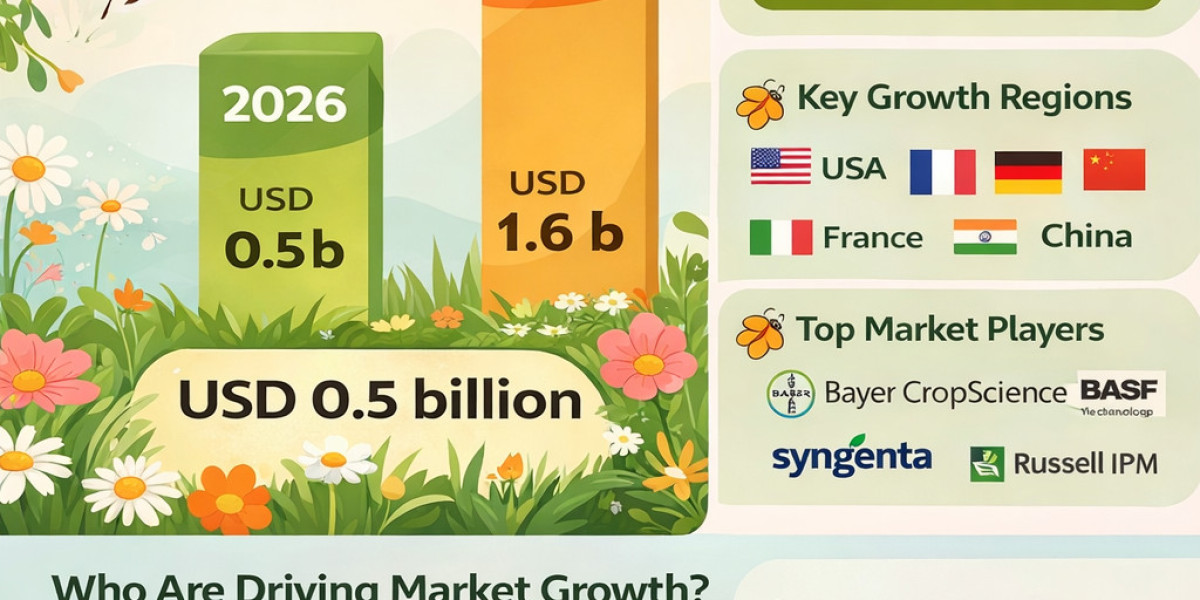

The global pollinator-safe floral attractant & repellent blend market is projected to grow from USD 0.5 billion in 2026 to USD 1.6 billion by 2036, registering a strong CAGR of 12.4%. Rising concerns over pollinator decline, stricter pesticide regulations, and growing demand for sustainable crop protection solutions are accelerating adoption worldwide.
These advanced formulations are designed to attract beneficial pollinators such as bees and butterflies while repelling harmful pests—without harming non-target species. As agriculture shifts toward biodiversity preservation and ecological pest management, these blends are emerging as a strategic tool in integrated pest management (IPM) systems.
Key Takeaways
- Market Value (2026): USD 0.5 billion
- Forecast Value (2036): USD 1.6 billion
- Forecast CAGR (2026–2036): 12.4%
- Leading Functional Segment: Attractant-Dominant Blends (34% share)
- Leading Application Mode: Foliar Spray (46% share)
- Fast-Growth Countries: USA (13.6%), India (13.2%), France (12.8%)
- Core End Users: Fruit, vegetable, nut, and specialty crop growers
Regional Analysis
The United States leads global growth with a projected CAGR of 13.6%, driven by heightened awareness of pollinator decline and increasing regulatory pressure to reduce harmful pesticide exposure. Government-backed sustainability programs and consumer demand for eco-friendly produce are further boosting adoption.
France and Germany are witnessing strong growth, supported by strict environmental regulations and biodiversity-focused agricultural policies. European Union initiatives to limit pollinator-harmful substances are encouraging growers to transition toward targeted attractant-repellent technologies.
In China, the market is expanding steadily at 11.4% CAGR due to its large agricultural base and regulatory push toward safer pest management solutions. India, growing at 13.2%, benefits from its expanding agricultural sector and rising focus on sustainable crop yield enhancement.
Report Coverage & Deliverables
This report provides detailed quantitative and qualitative analysis of the pollinator-safe floral attractant & repellent blend market from 2026 to 2036. It includes:
- Revenue forecasts and CAGR projections
- Segmentation by functional blend type (Attractant-Dominant, Repellent-Dominant, Balanced Systems, Crop-Specific Floral Mimics)
- Application mode analysis (Foliar Spray, Dispenser/Lure Systems, Seed & Soil-Adjacent, Drone & Precision Placement)
- Regional and country-level insights across North America, Europe, Asia Pacific, Latin America, and Middle East & Africa
- Competitive landscape benchmarking and innovation trends
Market Dynamics and Growth Prospects
Market growth is primarily driven by increasing awareness of pollinator health and the need for sustainable pest management alternatives. Traditional broad-spectrum pesticides have faced criticism for negatively impacting bee populations and biodiversity. Pollinator-safe blends provide a targeted solution that enhances crop pollination while minimizing ecological disruption.
Foliar spray remains the dominant application mode due to its broad coverage and efficiency in large-scale agricultural operations. Meanwhile, dispenser and lure systems are gaining traction for precision-targeted applications in orchards and specialty crops.
To access the complete data tables and in-depth insights, request a sample report here
Innovation and Emerging Technologies
Innovation is centered on species-specific semiochemical formulations and bio-based ingredients. Advanced research into plant-insect signaling is enabling development of highly targeted blends that optimize pollinator attraction while deterring pest species.
Precision agriculture integration is another key trend. Drone-based deployment systems, AI-driven timing tools, and sensor-guided application methods are improving accuracy and minimizing waste.
Leading and Emerging Players Driving Competition
The competitive landscape features specialized crop science and semiochemical solution providers. Key players include Bayer CropScience, BASF SE, Syngenta Group, ISCA Technologies, and Russell IPM.
These companies compete through selective attractant chemistries, field-validated safety data, and integration within broader crop protection portfolios. ISCA Technologies emphasizes semiochemical-based targeting systems, while Russell IPM focuses on specialty crop and orchard applications.
Future Outlook
The pollinator-safe floral attractant & repellent blend market is poised for sustained double-digit growth through 2036. As sustainability becomes central to agricultural strategy, solutions that balance crop protection with biodiversity preservation will gain importance.
Advancements in precision application, semiochemical research, and bio-based formulations will shape the next phase of innovation. Companies that combine ecological performance validation with scalable deployment technologies will secure long-term competitive advantage in this rapidly evolving market.
Have a specific Requirements and Need Assistant on Report Pricing or Limited Budget please contact us – sales@futuremarketinsights.com
About Future Market Insights (FMI)
Future Market Insights, Inc. (FMI) is an ESOMAR-certified, ISO 9001:2015 market research and consulting organization, trusted by Fortune 500 clients and global enterprises. With operations in the U.S., UK, India, and Dubai, FMI provides data-backed insights and strategic intelligence across 30+ industries and 1200 markets worldwide.
Why Choose FMI: https://www.futuremarketinsights.com/why-fmi