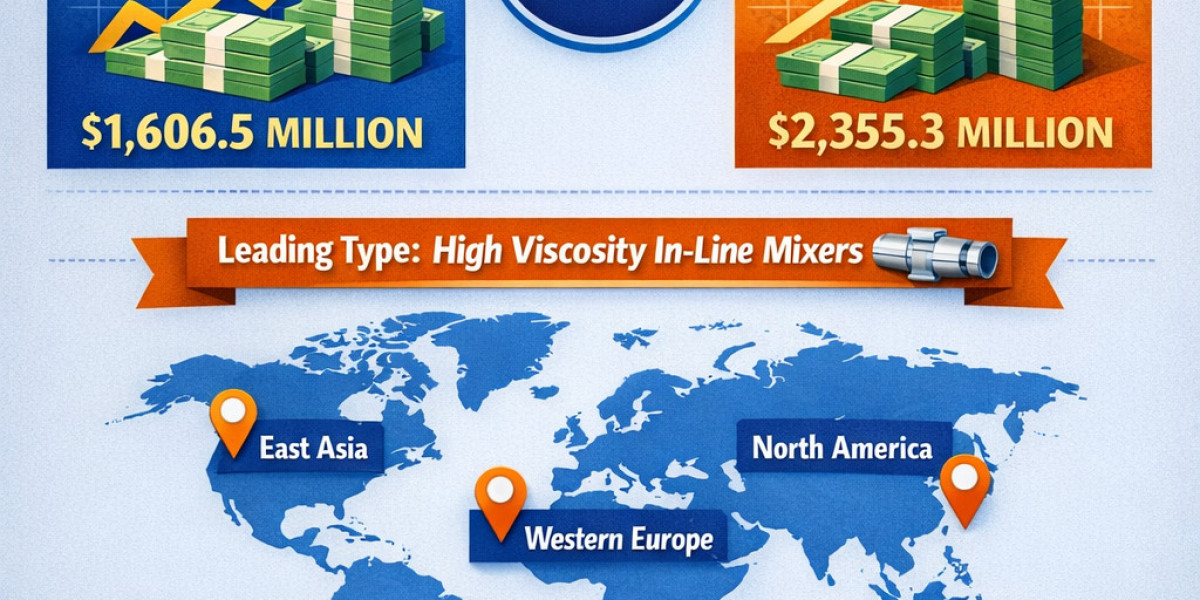

The High Viscosity Mixer Market is projected to grow from USD 1,606.5 million in 2025 to USD 2,355.3 million by 2035, registering a CAGR of 3.9%. Rising investments in pharmaceutical manufacturing, cosmetics formulation, and specialty chemical production are accelerating demand for advanced mixing systems capable of handling dense and complex materials.
As manufacturing facilities adopt automation and digital process controls, high viscosity mixers are becoming essential for ensuring batch consistency, viscosity precision, and operational efficiency.
Key Takeaways
- Market Value (2025): USD 1,606.5 million
- Forecast Value (2035): USD 2,355.3 million
- CAGR (2025–2035): 3.9%
- Leading Type: High Viscosity In-Line Mixers (52% share)
- Primary Application: Pharmaceuticals (25% share)
- Key Growth Regions: East Asia, North America, Western Europe
- Top Growth Countries: China (5.3%), India (4.9%), Germany (4.5%)
Regional Analysis
East Asia leads global growth, with China registering the fastest expansion at 5.3% CAGR, supported by pharmaceutical infrastructure development and industrial modernization. India follows at 4.9%, benefiting from government-backed manufacturing programs and drug production growth.
In Western Europe, Germany maintains strong momentum with a 4.5% growth rate due to advanced process engineering and strict quality standards. The United Kingdom and France show steady demand driven by pharmaceutical innovation and production upgrades.
North America records stable growth, led by the United States at 3.7% CAGR, where regulatory-driven compliance and digital manufacturing integration support equipment replacement cycles. Brazil leads Latin America at 4.1%, supported by chemical and pharmaceutical facility modernization.
Market Dynamics and Growth Prospects
Market growth is fueled by manufacturing expansion, pharmaceutical R&D investment, and process automation initiatives. From 2025 to 2030, the market will add approximately USD 338.7 million, driven by rapid adoption of programmable control systems and real-time viscosity monitoring. Between 2030 and 2035, the market will gain an additional USD 410.1 million as advanced systems integrate with Manufacturing Execution Systems (MES) and smart production platforms.
Key drivers include increasing demand for emulsification, polymer blending, and precision mixing in drug formulation and cosmetics manufacturing. However, high equipment costs and competition from traditional mixing technologies may slow adoption among small and mid-sized facilities.
To access the complete data tables and in-depth insights, request a sample report here
Innovation and Emerging Technologies
Technological advancement is reshaping the competitive landscape. Manufacturers are integrating IoT-enabled monitoring, automated control panels, and predictive maintenance features into next-generation mixers. Enhanced in-line systems now offer improved energy efficiency, programmable parameters, and seamless data integration.
Compact static mixers continue to serve specialized batch processing needs, while hybrid configurations provide operational flexibility. Digital dashboards and automation-ready designs are enabling higher throughput and reduced material waste across production environments.
Leading and Emerging Players Driving Competition
The market features a mix of global manufacturers and regional specialists. Key participants include SIEHE Group, Resodyn Acoustic Mixers, Silverson, ROSS, Inoxpa, and Hockmeyer.
Market leaders compete on engineering innovation, distribution strength, and system customization capabilities. The top players collectively account for a significant portion of global revenue, while regional suppliers differentiate through localized compliance expertise and responsive service networks.
Report Coverage & Deliverables
The report provides quantitative forecasts from 2025 to 2035, covering revenue by type (high viscosity in-line mixers, static mixers), application (pharmaceuticals, cosmetics, food, adhesives & sealants), and end use (pharmaceutical companies, cosmetics manufacturers, food processors, chemical companies).
Regional analysis spans North America, Latin America, Western and Eastern Europe, East Asia, South Asia Pacific, and Middle East & Africa, with country-level insights for China, India, Germany, Brazil, the United States, the United Kingdom, and Japan. The study also includes competitive benchmarking, innovation analysis, procurement trends, and strategic growth recommendations.
Future Outlook
The High Viscosity Mixer Market is set for steady expansion as industries transition toward digitally integrated manufacturing ecosystems. Companies investing in automation compatibility, precision engineering, and application-specific customization will strengthen competitive positioning.
As pharmaceutical and specialty production continues to evolve, high viscosity mixing systems will remain critical for ensuring product consistency, regulatory compliance, and operational reliability through 2035.
Have a specific Requirements and Need Assistant on Report Pricing or Limited Budget please contact us – sales@futuremarketinsights.com
About Future Market Insights (FMI)
Future Market Insights, Inc. (FMI) is an ESOMAR-certified, ISO 9001:2015 market research and consulting organization, trusted by Fortune 500 clients and global enterprises. With operations in the U.S., UK, India, and Dubai, FMI provides data-backed insights and strategic intelligence across 30+ industries and 1200 markets worldwide.
Why Choose FMI: https://www.futuremarketinsights.com/why-fmi