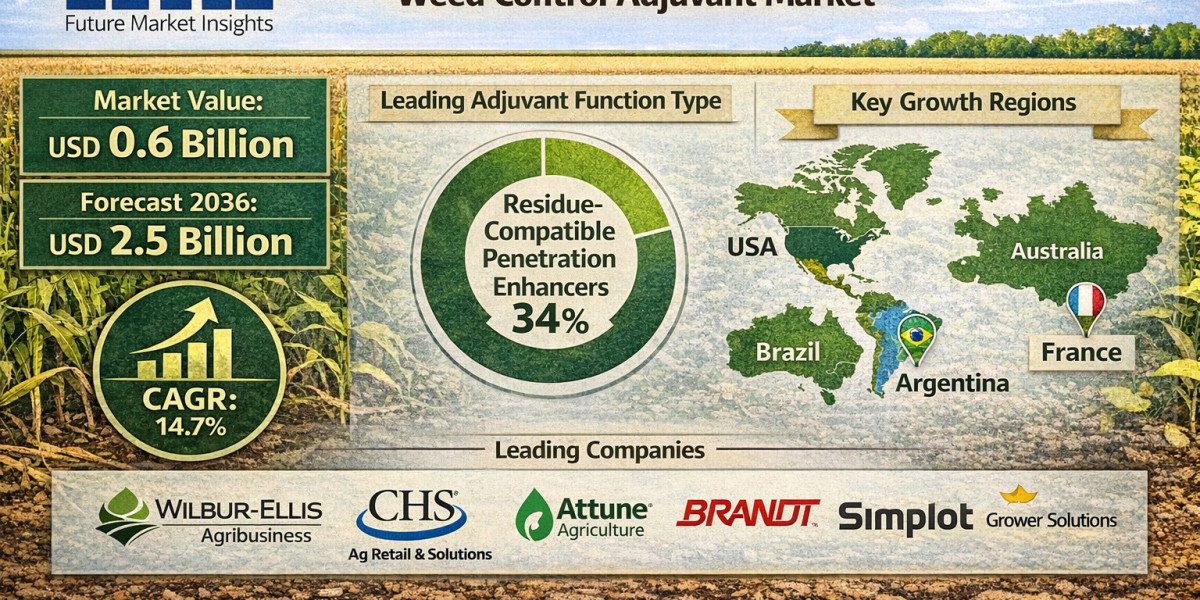

The global regenerative no-till compatible weed control adjuvant market is poised for robust expansion, growing from USD 0.6 billion in 2026 to USD 2.5 billion by 2036 at a CAGR of 14.7%. Rising adoption of regenerative agriculture and conservation tillage practices is accelerating demand for advanced adjuvants that enhance herbicide efficacy while preserving soil integrity. As farmers prioritize soil health, carbon sequestration, and erosion control, no-till compatible formulations are becoming essential components of sustainable crop management strategies.
Residue-compatible penetration enhancers lead with a 34% share, while row crops such as corn, soybean, and cotton account for 49% of total demand, reflecting their heavy reliance on efficient weed control in reduced-tillage systems.
Key Takeaways
- Market Value (2026): USD 0.6 Billion
- Forecast Value (2036): USD 2.5 Billion
- CAGR (2026–2036): 14.7%
- Leading Function Type: Residue-Compatible Penetration Enhancers (34%)
- Dominant Crop System: Row Crops (49%)
- Fastest Growing Country: USA (15.5% CAGR)
Market Dynamics and Growth Prospects
The market is advancing as growers increasingly adopt regenerative and no-till systems designed to enhance soil structure, reduce erosion, and improve long-term farm productivity. However, minimizing soil disturbance elevates reliance on chemical weed control solutions. Specialized adjuvants improve spray retention, herbicide uptake, rainfastness, and drift control under residue-rich conditions typical of no-till fields.
Traditional adjuvants may disrupt soil biology or underperform in conservation systems. In contrast, regenerative-compatible formulations are engineered to optimize herbicide efficiency while maintaining ecological balance. Rising regulatory focus on sustainable agriculture and climate-smart farming further supports adoption. Government incentives in major agricultural economies are reinforcing transitions toward low-disturbance systems.
To access the complete data tables and in-depth insights, request a sample report here
Regional Analysis
The United States leads with a 15.5% CAGR, supported by rapid expansion of regenerative farming practices and policy backing for soil conservation. Brazil follows at 14.9%, driven by its large soybean and sugarcane cultivation areas and the need for effective weed management in extensive no-till acreage.
Australia grows at 15.2%, reflecting its commitment to soil preservation and resilience in arid conditions. Argentina (14.6%) continues leveraging widespread no-till adoption in grain production. France, expanding at 13.8%, benefits from strict environmental regulations and increasing conservation agriculture uptake.
Innovation and Emerging Technologies
Innovation in adjuvant chemistry is reshaping the market landscape. New-generation residue-compatible penetration enhancers improve herbicide absorption without disturbing crop residues. Multifunctional formulations combining low-drift properties, enhanced adhesion, and wash-off resistance are gaining traction.
Bio-based and low-toxicity adjuvants are emerging as attractive alternatives, aligning with sustainability certifications and eco-labeling standards. Integration with precision agriculture technologies—including variable-rate spraying and sensor-guided application—is enhancing efficiency and reducing waste.
Leading and Emerging Players Driving Competition
The competitive landscape features agricultural solution providers emphasizing field performance and sustainability alignment.
Key companies include:
- Wilbur-Ellis Agribusiness
- CHS Inc. (Ag Retail & Solutions)
- Attune Agriculture
- Brandt Consolidated
- Simplot Grower Solutions
These players differentiate through tailored formulations, technical agronomy support, and compatibility with leading herbicide programs. Companies are strengthening distribution networks and advisory services to support grower adoption in conservation systems.
Report Coverage & Deliverables
This report provides comprehensive market intelligence, including:
- Market size and 10-year forecast (2026–2036) in USD billion
- Segmentation by adjuvant function type and crop system
- Regional and country-level CAGR analysis
- Distribution channel insights across agricultural suppliers and eco-friendly farming programs
- Competitive benchmarking of global and regional suppliers
- Innovation trends in regenerative-compatible formulations
Future Outlook
The regenerative no-till compatible weed control adjuvant market is positioned for sustained double-digit growth as agriculture shifts toward climate-resilient and soil-first strategies. With expanding no-till acreage and increasing regulatory support for sustainable farming, demand for performance-enhancing yet environmentally aligned adjuvants will continue rising.
As growers seek solutions that deliver effective weed suppression without compromising soil health, companies that combine agronomic expertise, technological innovation, and sustainability integration will define the competitive frontier through 2036.
Have a specific Requirements and Need Assistant on Report Pricing or Limited Budget please contact us – sales@futuremarketinsights.com
About Future Market Insights (FMI)
Future Market Insights, Inc. (FMI) is an ESOMAR-certified, ISO 9001:2015 market research and consulting organization, trusted by Fortune 500 clients and global enterprises. With operations in the U.S., UK, India, and Dubai, FMI provides data-backed insights and strategic intelligence across 30+ industries and 1200 markets worldwide.
Why Choose FMI: https://www.futuremarketinsights.com/why-fmi