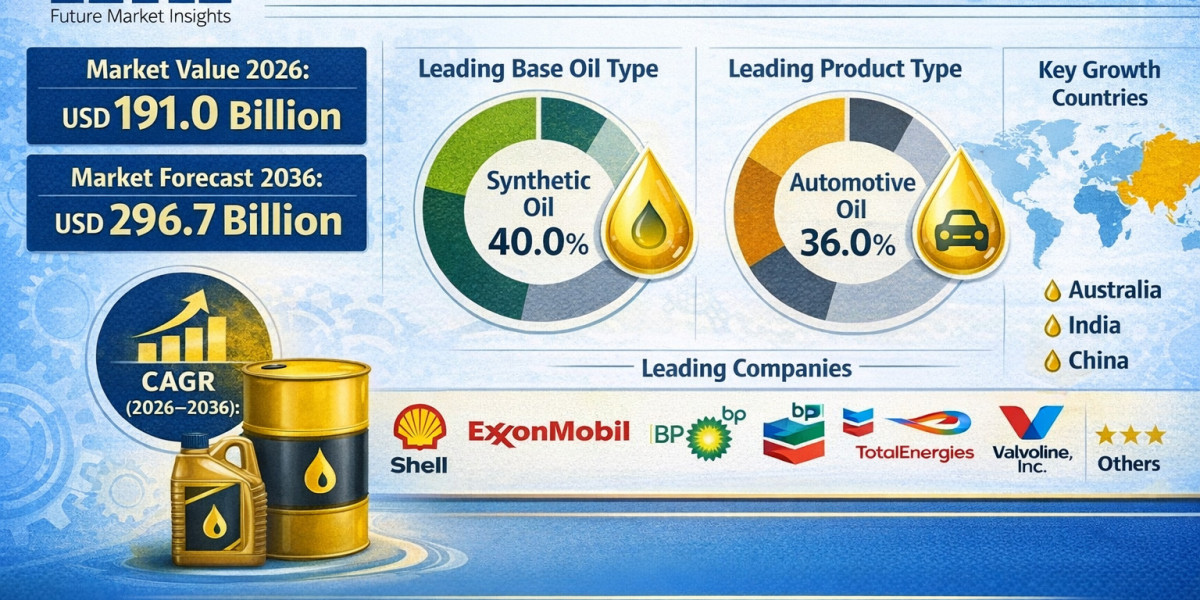

The global lubricant market is projected to expand from USD 191.0 billion in 2026 to USD 296.7 billion by 2036, registering a CAGR of 4.5%. Growth is supported by stable servicing cycles across automotive fleets and reliability-focused procurement across industrial operations. Buyers are prioritizing formulation consistency, OEM-compliant specifications, and predictable drain intervals to reduce total cost of ownership.
Synthetic oils lead the base oil mix with a 40% share, while automotive oil dominates product demand at 36%. Automotive remains the largest end-user vertical at 37%, reflecting the scale of global vehicle servicing and maintenance ecosystems.
Key Takeaways
- Market Size (2026): USD 191.0 Billion
- Market Size (2036): USD 296.7 Billion
- CAGR (2026–2036): 4.5%
- Leading Base Oil Type: Synthetic Oil (40%)
- Leading Product Type: Automotive Oil (36%)
- Leading End-User Vertical: Automotive (37%)
- High-Growth Countries: Australia, India, China
Market Dynamics and Growth Prospects
Lubricant demand remains anchored to the global installed base of passenger vehicles, commercial fleets, heavy machinery, and industrial systems requiring routine maintenance. Structured servicing intervals and fleet maintenance programs provide predictable replenishment cycles, sustaining category stability.
Specification-driven purchasing is reshaping product positioning. Buyers increasingly rely on OEM approvals, viscosity grades, and performance certifications to reduce substitution risk. This strengthens synthetic oil penetration, particularly in high-temperature and extended-drain applications.
Industrial demand remains stable in hydraulics, metalworking, and compressor systems where uptime metrics directly influence procurement decisions.
To access the complete data tables and in-depth insights, request a sample report here
Innovation and Emerging Technologies
Innovation is focused on performance enhancement and service-life extension. Advanced additive technologies improve oxidation resistance, deposit control, and wear protection, enabling longer drain intervals and improved fuel efficiency.
Synthetic and semi-synthetic formulations continue to gain traction, particularly in high-load and temperature-intensive environments. Development of bio-based oils and environmentally adapted lubricants is also emerging, particularly in marine and industrial sectors subject to sustainability regulations.
Regional Analysis
Australia leads growth at a 7.0% CAGR, supported by service-intensive maintenance across automotive fleets and mining-linked industrial equipment. India follows at 6.9%, driven by vehicle parc expansion and increasing manufacturing activity.
China is projected to grow at 5.9%, supported by industrial output scale and expanding automotive servicing networks. The United States expands at 4.4%, sustained by a mature service economy and strong distributor ecosystems. Japan, at 3.4%, reflects measured growth in a highly structured and specification-focused market.
Growth differentiation across regions is influenced by vehicle ownership trends, industrial intensity, and synthetic penetration rates.
Leading and Emerging Players Driving Competition
Competition is defined by formulation performance, claims governance, and channel execution strength. Major players include:
- Shell plc
- ExxonMobil Corporation
- BP p.l.c. (Castrol)
- Chevron Corporation
- TotalEnergies SE
- Valvoline Inc.
- FUCHS SE
- Sinopec Lubricant Company
- Indian Oil Corporation Ltd.
- Petronas Lubricants International
- Phillips 66
- Motul
- Gulf Oil International
- Idemitsu Kosan
- Repsol
Report Coverage & Deliverables
This report delivers comprehensive analysis including:
- Market size and forecast (2026–2036) in USD billion
- Segmentation by base oil type: Synthetic, Mineral, Bio-based
- Product type analysis: Automotive Oil, Hydraulic Oil, Metalworking Fluid, Gear Oil, Compressor Oil, Greases
- End-user vertical insights across Automotive, Industrial, Oil & Gas, Marine, Chemical, Aerospace, and others
- Regional breakdown across North America, Europe, Asia Pacific, Latin America, and Middle East & Africa
- Competitive benchmarking and portfolio positioning
Future Outlook
The lubricant market will continue evolving toward higher-specification formulations and disciplined portfolio strategies. Synthetic penetration, compliance readiness, and distributor enablement will shape competitive advantage.
As fleet operators and industrial buyers prioritize uptime, reliability, and maintenance efficiency, suppliers offering validated performance claims and stable supply assurance will secure stronger loyalty. Through 2036, the market will balance steady volume growth with premiumization trends, reinforcing lubricants as a performance-critical input across global automotive and industrial ecosystems.
Have a specific Requirements and Need Assistant on Report Pricing or Limited Budget please contact us – sales@futuremarketinsights.com
About Future Market Insights (FMI)
Future Market Insights, Inc. (FMI) is an ESOMAR-certified, ISO 9001:2015 market research and consulting organization, trusted by Fortune 500 clients and global enterprises. With operations in the U.S., UK, India, and Dubai, FMI provides data-backed insights and strategic intelligence across 30+ industries and 1200 markets worldwide.
Why Choose FMI: https://www.futuremarketinsights.com/why-fmi