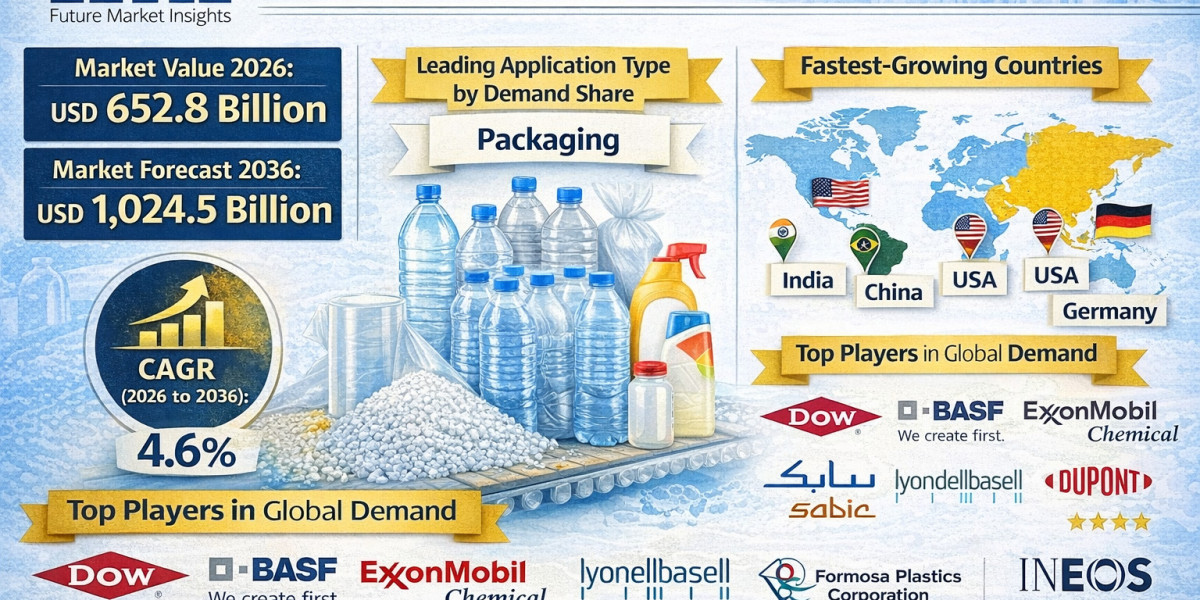

The global plastic market is projected to grow from USD 652.8 billion in 2026 to USD 1,024.5 billion by 2036, advancing at a CAGR of 4.6%. Growth reflects sustained demand across packaging, automotive, construction, and consumer goods, alongside tightening regulatory frameworks focused on chemical safety, recycling standards, and circular economy compliance. Governments worldwide are reinforcing material traceability, recycled content mandates, and extended producer responsibility (EPR) programs.
As sustainability targets intensify, manufacturers are balancing production scale with environmental stewardship, investing in recyclable materials, quality-controlled supply chains, and compliance-driven product development.
Key Takeaways
- Market Value (2026): USD 652.8 Billion
- Forecast Value (2036): USD 1,024.5 Billion
- CAGR (2026–2036): 4.6%
- Leading Application: Packaging (39.2%)
- Dominant Material: Polyethylene (28.4%)
- Fastest-Growing Countries: India (5.8%), China (5.2%), Brazil (4.9%), USA (4.3%), Germany (4.1%)
- Major Players: Dow, BASF, ExxonMobil Chemical, SABIC, LyondellBasell, DuPont, Formosa Plastics, Ineos
Market Dynamics and Growth Prospects
Demand for plastics continues to expand across high-volume and high-performance applications. Packaging remains the largest segment, driven by food safety requirements, product protection standards, and lightweight design advantages. Automotive manufacturing benefits from plastics’ strength-to-weight ratio, supporting fuel efficiency and design flexibility. Construction applications rely on durability, chemical resistance, and weather performance.
Regulatory pressure is a defining growth influence. Chemical safety laws restrict hazardous additives, particularly for food-contact and healthcare applications. Environmental mandates increasingly target single-use plastics, waste segregation, and landfill diversion. Extended producer responsibility frameworks require companies to manage post-consumer waste through recycling and recovery systems.
Recycling standards and circular economy strategies are reshaping procurement behavior. Buyers now prioritize recycled-content compliance, traceability systems, and design-for-recyclability frameworks to meet sustainability benchmarks without compromising performance.
To access the complete data tables and in-depth insights, request a sample report here
Innovation and Emerging Technologies
Material science innovation is central to market evolution. Polyethylene and polypropylene grades are being engineered for enhanced mechanical strength and improved recyclability. Advances in molecular design improve flow properties, processing stability, and environmental resistance.
Chemical recycling technologies are emerging to complement mechanical recycling, enabling recovery of mixed or contaminated plastic streams. Bio-based polymers and biodegradable formulations are also gaining development attention, particularly in packaging and specialty consumer segments.
Regional Analysis
India leads global growth at a 5.8% CAGR, driven by manufacturing expansion, packaging demand, and infrastructure development. China follows at 5.2%, supported by automotive production, large-scale manufacturing systems, and export-oriented polymer processing.
Brazil expands at 4.9%, reflecting increased industrial output and packaging modernization. The United States grows at 4.3%, supported by advanced manufacturing, food packaging demand, and circular economy initiatives. Germany records 4.1% CAGR, driven by quality-driven industrial standards and automotive sector stability.
Asia Pacific remains the largest production and consumption hub, while Europe emphasizes sustainability compliance and recycling integration. North America balances production strength with regulatory-driven packaging transformation.
Leading and Emerging Players Driving Competition
Competition centers on molecular consistency, supply reliability, and sustainability alignment. Leading producers include:
- Dow Chemical Company
- BASF SE
- ExxonMobil Chemical
- SABIC
- LyondellBasell Industries
- DuPont de Nemours Inc.
- Formosa Plastics Corporation
- Ineos Group
Report Coverage & Deliverables
The report provides comprehensive analysis including:
- Market size and 10-year forecast (USD billion)
- Segmentation by application: Packaging, Automotive, Construction, Consumer Goods
- Material type breakdown: Polyethylene, Polypropylene, PVC, Polystyrene, Others
- End-use industry performance insights
- Country-level growth analysis across 40+ markets
- Competitive benchmarking and procurement dynamics
Future Outlook
Through 2036, the plastic market will balance industrial expansion with environmental accountability. Regulatory compliance, recycled content integration, and advanced material design will define competitive advantage.
Manufacturers that combine scalable production capacity with sustainability-focused innovation and traceable supply systems will secure stronger long-term positioning. While volume growth remains steady, value creation will increasingly depend on performance efficiency, circular economy alignment, and regulatory readiness across global markets.
Have a specific Requirements and Need Assistant on Report Pricing or Limited Budget please contact us – sales@futuremarketinsights.com
About Future Market Insights (FMI)
Future Market Insights, Inc. (FMI) is an ESOMAR-certified, ISO 9001:2015 market research and consulting organization, trusted by Fortune 500 clients and global enterprises. With operations in the U.S., UK, India, and Dubai, FMI provides data-backed insights and strategic intelligence across 30+ industries and 1200 markets worldwide.
Why Choose FMI: https://www.futuremarketinsights.com/why-fmi